

OpenClaw AI is redefining what autonomous AI agents can do in 2026. Artificial Intelligence is evolving beyond chatbots, and OpenClaw AI represents the shift toward systems that can plan, decide, and execute tasks across the web without constant prompting.
One of the most talked about projects in this space is OpenClaw AI. This open-source framework turns large language models into autonomous digital operators that live inside your messaging apps and interact with websites on your behalf.
In this guide, we explain what OpenClaw AI is, how it works, how to install it, how it compares to other agent frameworks, and whether it is worth using in 2026.
What Is OpenClaw AI?
OpenClaw AI is an open-source autonomous agent framework that enables large language models to perform real-world digital tasks.
Unlike a traditional chatbot interface, OpenClaw is designed to:
- Execute multi-step workflows
- Use external tools and APIs
- Control a headless browser
- Operate through messaging platforms
- Run continuously with minimal supervision
The project was originally known as Clawdbot and briefly Moltbot. It is built around the idea that AI should not only generate text but also take action.
Why Autonomous AI Agents Matter in 2026
For years, AI tools followed a simple pattern. You ask a question. The model responds. The interaction ends.
Autonomous AI agents change this model completely. Instead of responding once, they:
- Plan tasks step by step
- Make decisions based on new information
- Use tools to achieve goals
- Monitor results and adjust behavior
This shift is often called agentic AI. It represents the transition from reactive AI to proactive AI.
Search interest in terms like autonomous AI agents, self-hosted AI agent, and AI automation framework has increased significantly in 2026. OpenClaw is positioned directly inside this trend.
How OpenClaw AI Works
OpenClaw acts as an orchestration layer around a large language model. The LLM provides intelligence. OpenClaw provides action.
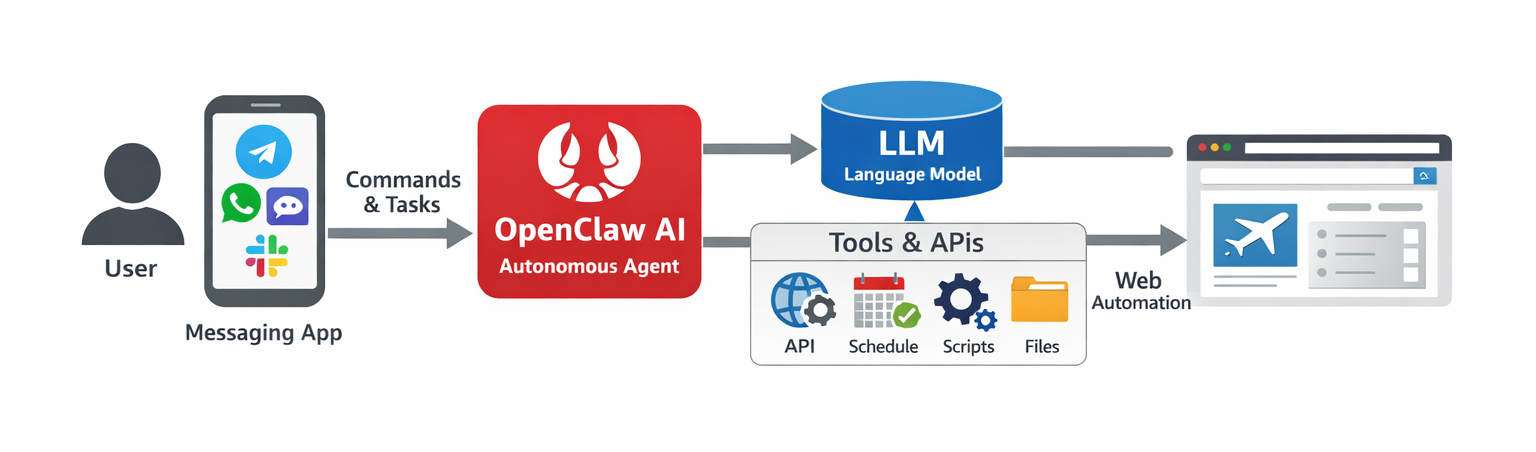
1. LLM Brain
The agent connects to a model provider such as OpenAI, Anthropic, or a locally hosted model. This powers reasoning and planning.
2. Skill System
OpenClaw uses modular skills, sometimes referred to as claws. Each skill allows the agent to interact with a specific tool.
Examples include:
- Web browsing
- Form submission
- API interaction
- File handling
- Scheduling
3. Messaging Integration
The agent can live inside Telegram, WhatsApp, Discord, or Slack. Instead of opening a separate dashboard, you interact with it through chat.
4. Headless Browser Automation
OpenClaw can control a headless browser to navigate websites, collect information, or complete multi-step actions such as booking tickets or filling out SaaS forms.
This makes it similar to lightweight robotic process automation, but powered by language reasoning.
How to Install and Self-Host OpenClaw AI
Many users search for how to install OpenClaw or how to self-host an AI agent. Below is a simplified overview of the setup process.
Step 1: Clone the Repository
Download the OpenClaw repository from its official source and install dependencies.
Step 2: Configure Your LLM Provider
Add your API key for OpenAI, Anthropic, or configure a local model.
Step 3: Set Up Messaging Integration
Create a bot inside Telegram or another supported platform and connect it to your OpenClaw instance.
Step 4: Launch the Agent
Start the service. Your autonomous AI agent is now accessible via chat.
Because OpenClaw is self-hosted, your configuration files and interaction history remain under your control.
OpenClaw vs AutoGPT vs OpenAI Agents
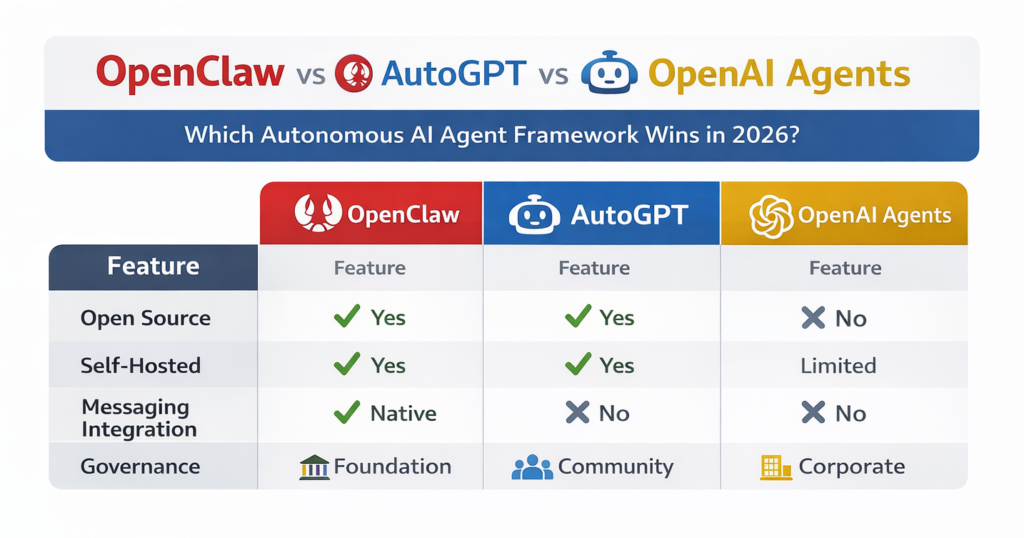
Many users compare OpenClaw with other autonomous AI agent frameworks. Here is a simplified overview.
| Feature | OpenClaw | AutoGPT | OpenAI Agents |
|---|---|---|---|
| Open Source | Yes | Yes | No |
| Self-Hosted | Yes | Yes | Limited |
| Messaging Native | Yes | No | No |
| Foundation Governance | Yes | Community | Corporate |
OpenClaw focuses heavily on messaging integration and modular skill architecture. AutoGPT is more experimental and developer-centric. OpenAI Agents offer deep integration with OpenAI infrastructure but less openness.
This comparison helps capture search queries like OpenClaw vs AutoGPT and best autonomous AI agents 2026.
Best Use Cases for OpenClaw AI
1. Research Automation
- Competitive analysis
- Daily news summaries
- Market monitoring
2. Marketing and SEO
- Tracking trending topics
- Generating structured content briefs
- Monitoring competitor websites
3. Developer Workflows
- API testing
- Dashboard automation
- Bug report aggregation
4. Creative Asset Management
- Organizing AI-generated images
- Tagging large content libraries
- Preparing media for publication
Because OpenClaw can operate through a browser and messaging interface, it can adapt to many digital workflows.
FAQ
OpenClaw AI is an open-source autonomous agent framework that allows large language models to perform multi-step digital tasks. Instead of only generating text responses, it can interact with messaging platforms, use tools, and navigate the web through browser automation. It acts as an orchestration layer that turns an LLM into a task-executing digital agent.
The answer depends on your goals. OpenClaw focuses on messaging-native integration, modular skills, and self-hosted control, making it suitable for users who want structured automation inside real communication environments. AutoGPT is more experimental and often centered around autonomous loops and developer experimentation. Each framework serves slightly different use cases within the broader autonomous AI space.
Yes, OpenClaw is designed to be self-hosted. You can deploy it on your own server and connect it to either cloud-based model providers or locally hosted large language models. This gives users more control over infrastructure, data storage, and API key management.
OpenClaw itself is a framework, but it can integrate with external image generation APIs. When connected to supported services, it can generate images and deliver them directly through the messaging interface, making it possible to manage visual workflows within the same autonomous system.